Cerebral Cortex Detects Which of the Following Taste Sensations
Taste receptors -- facial glassopharyngeal. The brain interprets the sensation as taste.

Gustatory Pathway Cranial Nerves Sensory System Internal Medicine
An important function of the primary somatosensory cortex is the ability for it to locate where specific sensations arise in the body.
. This area is where the integration of taste and smell takes place as well as the phenomenon of food reward. This region is also responsible for being able to perceive pressure through judging the degrees of pressure put on the body. The signal from the taste buds in the tongue to the brain moves between nerve cells through the release of special chemicals called neurotransmitters.
The primary gustatory cortex is a brain structure responsible for the perception of taste. From the nucleus of the solitary tract taste information goes to the thalamus and then to the cerebral cortex. There are more cones than rods in this region.
The sensory portion or intermediate nerve has the following components. Primary neurons synapse in the nucleus solitarius. 3 cutaneous sensory impulses from the external auditory meatus and region back of the ear.
A d b c d. What we often attribute to the sense of taste is actually the. The cerebral cortex which is the outer surface of the brain is associated with higher level processes such as consciousness thought emotion reasoning language and memory.
It is the primary gustatory cortex that is responsible for our sensations of taste. There are more rods than cones in this region. Which of the following taste sensations is the most sensitive Ie has the lowest stimulation threshold.
151 Taste Gustation Taste Only a few recognized submodalities exist within the sense of taste or gustation. Which of the following statements regarding the transmission of taste information from the tongue to the cerebral cortex is correct. The color receptors in the retina are most sensitive to light waves that are.
2 secretory and vasomotor fibers to the lacrimal gland the mucous membranes of the nose and mouth and the submandibular and sublingual salivary glands. Sweet salty sour and bitter. - accounts for most of what we perceive as taste - involves modified neurons - sends signals to the olfactory cortex in the temporal lobe Sense of taste.
Additionally secondary fibers travel from the gustatory cortex to the posterolateral portion of the orbitofrontal cortex OFC. Ganglia cells detect changes in bipolar cell activity. C d a b.
D c b a e. Salty taste is simply the perception of sodium ions Na in the salivaWhen you eat something salty the salt crystals dissociate into the component ions Na and Cl which dissolve into the saliva in your mouthThe Na concentration becomes high outside the gustatory cells creating a strong concentration gradient that drives the diffusion of the ion into the cells. The optic disc is located on the side of the retina.
This allows us to pinpoint the exact location of touch pain and pressure for instance. A b c d b. There are no rods in this region.
Which of the following is NOT one of the six primary taste sensations. Until recently only four tastes were recognized. 1 taste to the anterior two-thirds of the tongue.
The route that the sensation of taste follows is a. From there much of the information is carried to the thalamus and then routed to the primary gustatory cortex located near the inferior margin of the post-central gyrus. Like information for smell taste information also goes to the limbic system hypothalamus and amygdala.
They respond to several primary tastes. The brain interprets the sensations as taste. Smell information also goes to the thalamus a structure that serves as a relay station for all of the sensory information coming into the brain.
- a chemical sense - involves chemoreceptors - molecules bind to microvilli receptor proteins of and generate nerve signals in sensory nerve fibers. The overall function of these third-order fibers is to provide discriminatory taste sensations. Axons from the three cranial nerves carrying taste information travel to the medulla.
The first four tastes need little explanation. Research at the turn of the 20th century led to recognition of. There are more rods than cones in this region.
The primary tastes detected by humans are sweet sour bitter salty and umami. Together the lobes serve many conscious and unconscious functions. It consists of two substructures.
Once a stimulus activates the gustatory impulse receptor cells synapse with neurons and pass on electrical impulses to the gustatory area of the cerebral cortex. Trace the gustatory pathway from the taste receptors to the cerebral cortex. The thalamus transmits some of this smell information to the orbitofrontal cortex where it can then be integrated with taste information.
The anterior insula on the insular lobe and the frontal operculum on the inferior frontal gyrus of the frontal lobe. The cranial nerves carry taste information into the brain to a part of the brain stem called the nucleus of the solitary tract. B c a d c.
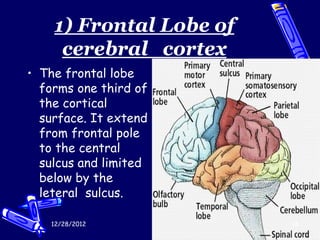
Tertiary neurons travel to the primary gustatory cortex. When a stimulus activates a gustatory cell the receptor will synapse with neurons and send an electrical impulse to the gustatory region of the cerebral cortex. Each cerebral hemisphere can be subdivided into four lobes each associated with different functions.
The specific distribution of the receptors enables us to map the tongue based on types of taste so that the apex predominantly detects sweetness the lateral margins detect saltiness the posterior part is for bitterness and sourness while umami is. In the next section well learn about the primary tastes and how taste gives us clues about what we eat. Primary axons pass along cranial nerves VII and IX.
Secondary neurons synapse in the thalamus. Because of its composition the primary gustatory cortex is sometimes referred to in literature as the AIFO. By using extracellular unit recording.
The following steps occur in rods when they are excited by photons of light. Sweet salty bitter sour umami savory and fat which some scientists claim might be a sixth taste. Finally the thalamus passes the signal onto a special area in the frontal lobe of the cerebral cortex the gustatory cortex where the taste signal is interpreted.

Sensory Cortex Visual Auditory Cortex Facts Summary
Which Part Of The Brain Controls Taste Quora

Olfactory Pathway Neuroscience Brainwave Entrainment Nasal Passages
Cerbral Cortex
No comments for "Cerebral Cortex Detects Which of the Following Taste Sensations"
Post a Comment